
 2/40 Royal Street Kenwick WA 6107
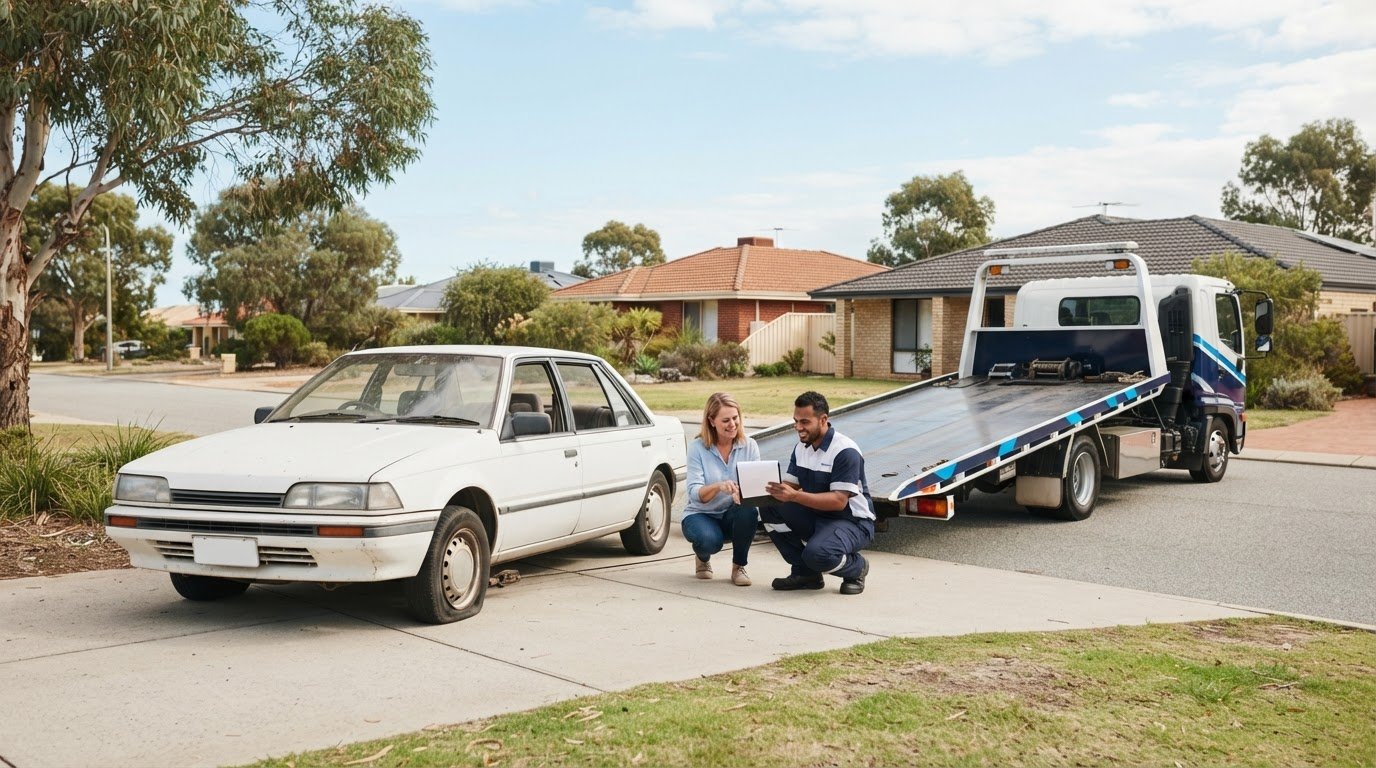
An unregistered car that won’t start can still be sold in Western Australia. You can sell it privately or to a dealer, and a roadworthy certificate isn’t required for a used-car sale. If you’re working out how to sell a car that doesn’t run in Perth, start by confirming ownership and deciding what to do with the number plates and registration.
If you’re wondering how to sell a car that doesn’t run in Perth, you can sell it privately or arrange removal through a car buyer. Be upfront about its condition, prepare the sale paperwork and organise collection rather than driving it on public roads.
This guide walks you through the practical steps, from checking ownership documents and handling registration to requesting quotes, comparing cash offers and organising removal. You’ll know what to prepare before the sale and how to choose a straightforward next step for a car that won’t run.
Key Takeaways
- You can sell a car without registration in Western Australia, and a roadworthy certificate isn’t required for a used-car sale.
- Gather proof of ownership and photo ID, then record the sale details in a signed receipt or contract.
- Be clear about the car’s condition when requesting quotes, as its make, model, age and state all affect the offer.
- Plan how the car will be collected; don’t drive an unregistered vehicle on public roads without a Temporary Movement Permit.
- Understand what happens to the number plates and registration before you complete the sale.
Proof of ownership and sale paperwork
Gather ownership documents before agreeing to sell. A clear, signed record helps both parties document the transfer.
-
Collect proof of ownership
Gather documents that connect you to the vehicle, such as purchase paperwork and its registration certificate. Check that the details match, including the registration details and vehicle identification number (VIN), where shown. If someone else is named on the paperwork, establish who has authority to sell before accepting an offer. Keep the original documents secure until the sale is complete.
-
Prepare photo ID and sale paperwork
Have valid photo identification ready to show you’re the seller named in the ownership documents. For a private sale in Western Australia, prepare proof of ownership, valid photo ID and a receipt or contract of sale. Get the paperwork ready before collection, rather than relying on a verbal agreement at handover.
- Write a receipt or contract that identifies the vehicle and records the agreement. Include the sale date, agreed price, VIN and engine number. Both you and the buyer should sign it. Check the details against the vehicle and its documents before signing, especially if the car won’t start and is difficult to move for inspection.
- Make the sale record specific about the vehicle’s condition and the handover. For example, describe it as non-running and note any known damage, rather than using a broad description such as “used car”. Keep a copy of the signed paperwork for your records. If you’re arranging removal of a truck, organise its ownership documents before arranging truck removal in Perth.
- Account for special ownership situations before signing. In Western Australia, transfers between spouses or de facto partners, and those involving a court order or deceased estate, are listed as cases for transfer by mail or in person. Vehicles with optional plates are also listed as requiring transfer by mail or in person. Include these details in your paperwork plan, rather than treating them as an ordinary handover.
- If finance is owing, contact the lender for a payout figure before finalising the sale. Use the sale proceeds to pay off the loan and cover any shortfall if they don’t clear it. Keep the lender’s payout details and proof of payment with your sale documents. This records how the finance was handled alongside the signed receipt or contract.
Can I Sell My Car Without Registration in Western Australia?
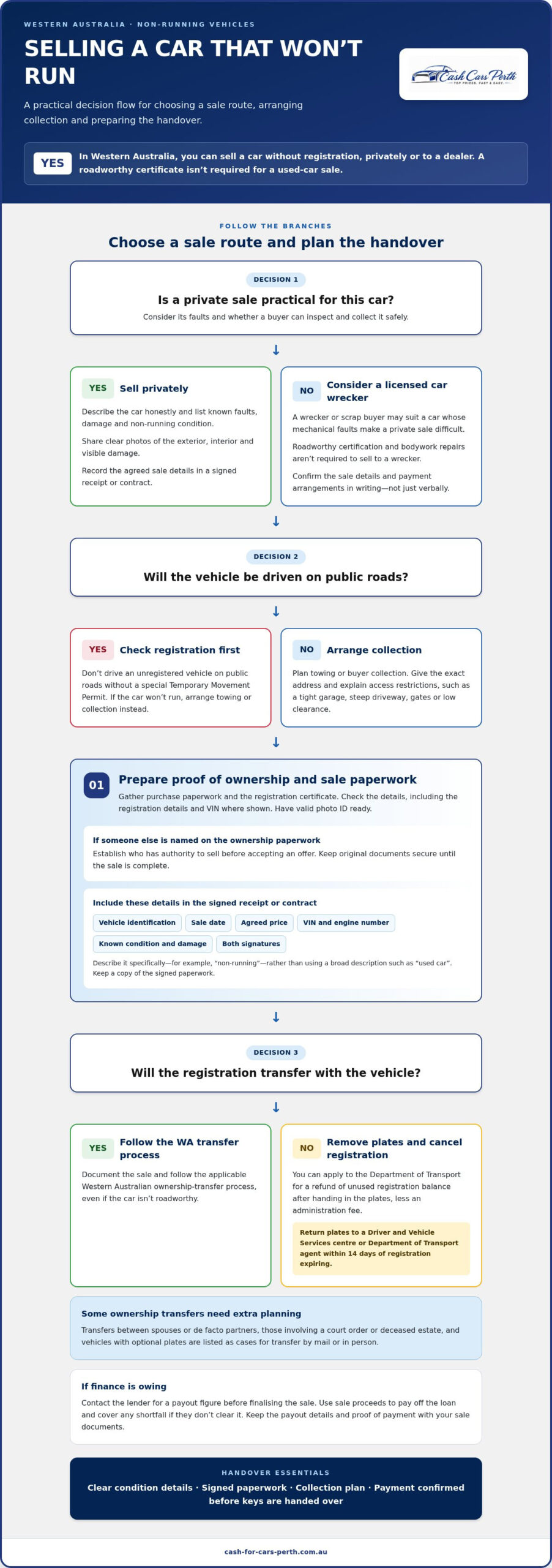
Yes. In Western Australia, you can sell a car privately or to a dealer without registration, and a roadworthy certificate isn’t required for a used-car sale.
- Describe the vehicle’s faults honestly. You can sell a non-running or accident-damaged car, or one with engine trouble, as-is in Perth. List known issues clearly, such as a failed engine, transmission fault or damage that stops the car starting. Don’t describe it as roadworthy or running if it isn’t. Clear details help prevent disagreement about what the buyer agreed to purchase.
- Prepare the car for sale without attempting repairs first. Remove personal belongings, gather the keys and ownership documents, and take clear photos of the exterior, interior and visible damage. Note symptoms you know, such as whether the engine turns over or warning lights appear. Don’t start or move the vehicle if doing so could create a safety risk.
- Decide how the unregistered car will leave its location. You can’t drive an unregistered vehicle on public roads without a special Temporary Movement Permit. Arrange towing or collection instead, and tell the buyer if the car is in a garage, driveway or tight-access area. Mention any access issues when discussing the handover.
-
Choose a licensed car wrecker
A car wrecker or scrap buyer can be an option if mechanical faults make a private sale difficult. In Western Australia, a roadworthy certificate or bodywork repairs aren’t required to sell a vehicle to a wrecker. Explain the car’s condition and confirm the agreed sale details in writing. Don’t hand over the vehicle based only on a verbal offer or unclear payment arrangements.
-
Transfer ownership and watch for risks
Document the sale and follow the applicable Western Australian transfer process, even if the car isn’t roadworthy. Transfers involving spouses or de facto partners, court orders, deceased estates or optional plates are listed as cases for transfer by mail or in person. For a private handover, meet in a public place, bring a friend, check the buyer’s ID, use a signed contract and wait for full payment before handing over the keys.
- If registration won’t transfer, remove the number plates and cancel the registration. You can apply to the Department of Transport for a refund of unused registration balance after handing in the plates, less an administration fee. Plates must be returned to a Driver and Vehicle Services centre or Department of Transport agent within 14 days of registration expiring. Keep a record of the handover and payment.
Service availability and removal timeframes
Plan collection around the car’s location, access and condition. These details help arrange towing and make the handover practical.
- Give the buyer the exact collection address and describe where the car is parked. A vehicle in a Perth driveway is different from one in a narrow garage or workplace basement. Mention gates, steep driveways, low clearance or restricted access. These details help plan suitable towing equipment before collection.
- Explain whether the car rolls, steers and can be accessed by a tow truck. Locked wheels or a flat tyre may require different loading arrangements from a car that simply won’t start. Note any damage around the wheels, suspension or body. Don’t assume the vehicle can move under its own power.
- Ask how the inspection will work before agreeing on a collection time. Clarify whether the buyer needs to inspect the damaged car in person or can first assess its details and photos. Share clear images of the vehicle, its surroundings and any access obstacles. Accurate information can reduce surprises at handover.
- Discuss the likely removal window after accepting an offer. A Perth car buyer may often collect on the same day the seller accepts an offer. Treat collection timing as part of the arrangement and settle the time, location and access details directly. Keep the car accessible and ensure someone authorised can complete the handover.
- Prepare the collection area before the tow truck arrives. Move other vehicles, bins or loose items that block access to the car. If it’s in a shared workplace or apartment garage, arrange access with the relevant site contact. Tell the buyer about height limits or entry restrictions before the truck departs.
- Keep the keys and sale paperwork ready, even if the car won’t start. Check that personal belongings are removed and the buyer can reach the vehicle safely. If the car was damaged in an accident, point out visible hazards or unstable parts. Clear access helps the tow operator load it safely.
- Confirm the handover details before collection. Make sure the agreed price, payment method, address and vehicle condition match your written record. If the truck can’t reach the car directly, discuss where loading can take place. Don’t hand over keys or paperwork until the agreed payment and transfer arrangements are complete.
Getting a cash offer
Build a clear picture of the car before requesting an offer. Make, model, age and condition can affect its value, along with current market and scrap metal prices.
- Write down the car’s identifying details: make, model, year, variant, odometer reading and whether it starts. Add the VIN if available. These details help a buyer assess the vehicle accurately instead of relying on a broad description such as “old hatchback”.
- Describe faults plainly and separate known problems from guesses. For example, say the engine won’t start rather than claiming it has failed if it hasn’t been diagnosed. Mention accident damage, missing components, transmission trouble or a flat battery. This helps the buyer assess the car’s condition when preparing an offer.
- Take current photos of the exterior, interior, odometer and visible damage. Include close-ups of dents, broken glass or missing parts. A photo of the engine bay can also show obvious damage. Don’t hide a fault with the camera angle or leave out a damaged panel, as a mismatch can affect the offer at inspection.
- Request the offer after you’ve assembled those details. The price depends on the case and is given after a quote request. Buyers weigh the make, model, age and condition against current market and scrap metal prices. A popular model with usable components may be assessed differently from a severely damaged car of similar age.
- Compare offers on the same basis. Check that each reflects the vehicle’s stated condition and collection arrangements. Ask for the proposed amount and payment method in writing. Before comparing a private buyer’s offer with another, understand whether either depends on repairs, inspection or a change in the car’s description.
- Consider whether a private sale suits the car’s faults. Private buyers may be wary of a non-running vehicle, offer less or decide not to buy it. Describe the condition clearly in your listing and discuss the car as-is. If it no longer runs, consider the time and effort involved in arranging viewings and removal.
- Before accepting, confirm the final offer, collection plan and payment arrangements. Ask what happens if an inspection reveals a fault you’ve already disclosed. Check that the written sale record reflects the agreed amount and condition. Hand over the keys only after full payment, and keep a copy of the signed sale paperwork.
Getting a quote for a non-running car
Give the buyer specific information about the car and its faults. A clear quote request helps assess the vehicle without assuming the engine still runs.
- Start with the vehicle’s make, model, year and variant. Add the odometer reading, VIN and Perth suburb. These details help identify the car and its location. If you’re unsure of the variant, use the details shown on its documents rather than guessing.
- Describe what happens when you try to start the engine. Say whether it turns over, makes a noise or stays silent. If you haven’t diagnosed the fault, report the symptom instead of naming a failed part. This helps avoid an inaccurate assessment.
- List other known problems separately. Mention accident damage, a faulty transmission, missing wheels or broken glass. Explain whether the car rolls and steers, since that affects collection arrangements. Private buyers may be cautious about mechanical faults, so a precise account helps them decide whether to make an offer.
- Send recent photos showing the whole vehicle and its condition. Include the dashboard, odometer, engine bay and close-ups of visible damage. Photograph missing parts or flat tyres too. Clear images add context to your description and help distinguish surface damage from a more serious issue.
- Provide the car’s location and access details with your quote request. Say whether it’s in a driveway, garage or workplace, and mention tight access or restricted entry. A non-running vehicle needs a removal plan, so these details help assess collection alongside its condition.
- Request a quote by phone or through the online form. Cash For Cars Perth’s process usually takes less than five minutes by phone, and the team aims to respond within an hour of your call. Have the vehicle details and fault description ready so you can answer questions without searching through paperwork.
- Ask what the offer covers before accepting. Check that it reflects the disclosed faults, vehicle condition and collection details. The assessment can consider the car’s make, model, age, condition, current market prices and scrap metal prices. Don’t compare figures until you understand what each offer includes.
- Confirm the agreed offer and payment arrangements in writing. If an inspection identifies a problem you already described, refer to your messages and photos. Keep your quote notes with the sale paperwork. This records the vehicle details, stated faults and agreed amount before collection.
Cash For Cars Perth: Scrap Car Removal
Cash For Cars Perth provides Scrap Car Removal for unwanted vehicles that no longer run. If your car has engine trouble, accident damage or other faults, this can be a practical alternative to managing a private sale. Cash for Unwanted Cars and Accident Car Removals are also available.
Share the car’s make, model, age, condition and location when requesting a quote. Describe known faults clearly so the vehicle can be assessed accurately. Once you’ve considered the offer and sale arrangements, organise the next step that suits your car.
Contact Cash For Cars Perth to discuss your non-running vehicle.
Choose the next step that suits your car
Your next move depends on whether you want to manage a private sale or move on from the vehicle with less negotiation. If you’re deciding how to sell a car that doesn’t run in Perth, focus on what you need: a buyer prepared to consider its condition, a clear handover and a removal plan that works for its location.
Cash For Cars Perth offers Scrap Car Removal and Cash for Unwanted Cars for vehicles you no longer need. Accident Car Removals are available for cars damaged in a collision. Share accurate vehicle details to discuss an option that fits its condition and your plans.
When you’re ready, request a free, no-obligation quote from Cash For Cars Perth. Share the car’s details and location to discuss removal and payment.
You’ve got a practical path forward. Choose the option that feels right for you.
Frequently Asked Questions
How does it work?
Start by sharing your car’s details through a quote request. Cash For Cars Perth can assess information such as the vehicle’s year, make, model, mileage and condition. If you proceed, an on-site inspection can help assess the vehicle before payment and removal are arranged. Have the keys available if you have them, but a missing key doesn’t rule out a non-running vehicle.
I just want to get rid of my car. What are my options?
You can sell it privately, approach a dealer or choose a vehicle removal service. The right option depends on whether you want to manage enquiries and viewings yourself or discuss the car directly with a buyer. For a damaged or unwanted car, Cash for Unwanted Cars and Scrap Car Removal are options to consider.
What paperwork do you need?
Prepare proof of ownership, valid photo identification and a written sale record. If someone else is named on the vehicle documents, establish who can authorise the sale before handover. A car with finance owing needs extra planning: obtain the lender’s payout figure and account for the loan when using sale proceeds. Keep copies of the signed paperwork and payment record together.
What are the options for selling a car that doesn’t run in Perth?
You can advertise it privately as non-running, approach a dealer or sell it for removal or wrecking. A private listing may suit a vehicle with faults that a buyer is willing to assess, but you’ll manage enquiries and collection arrangements. For an accident-damaged car, Cash For Cars Perth’s Accident Car Removals may be a better fit. Describe the fault accurately before choosing.
How do Perth car wreckers and scrap buyers value non-running cars?
They consider the vehicle’s make, model, age and condition, alongside current market and scrap metal prices. A car with a sought-after model and usable components may be assessed differently from a heavily damaged vehicle. Share the odometer reading, known mechanical faults and clear photos. If the engine won’t start, describe what happens rather than guessing at the cause.
Can you sell an unregistered or unroadworthy car in Perth, and what rules apply?
Yes. In Western Australia, you can sell a car privately or to a dealer without registration, and a roadworthy certificate isn’t required for a used-car sale. Don’t drive an unregistered vehicle on public roads without a special Temporary Movement Permit. If registration isn’t being transferred, remove the plates and cancel the registration. Plate return and transfer arrangements depend on the circumstances.
Is it better to sell a non-running car privately, to a wrecker, or for scrap in Perth?
Choose a private sale if you’re prepared to answer enquiries, arrange viewings and negotiate with buyers. A wrecker or scrap buyer may suit a car with substantial mechanical or accident damage, particularly when you want removal considered as part of the sale. Compare each option against the vehicle’s condition, your preferred handover process and the time you can spend arranging a sale.
0 Comments